
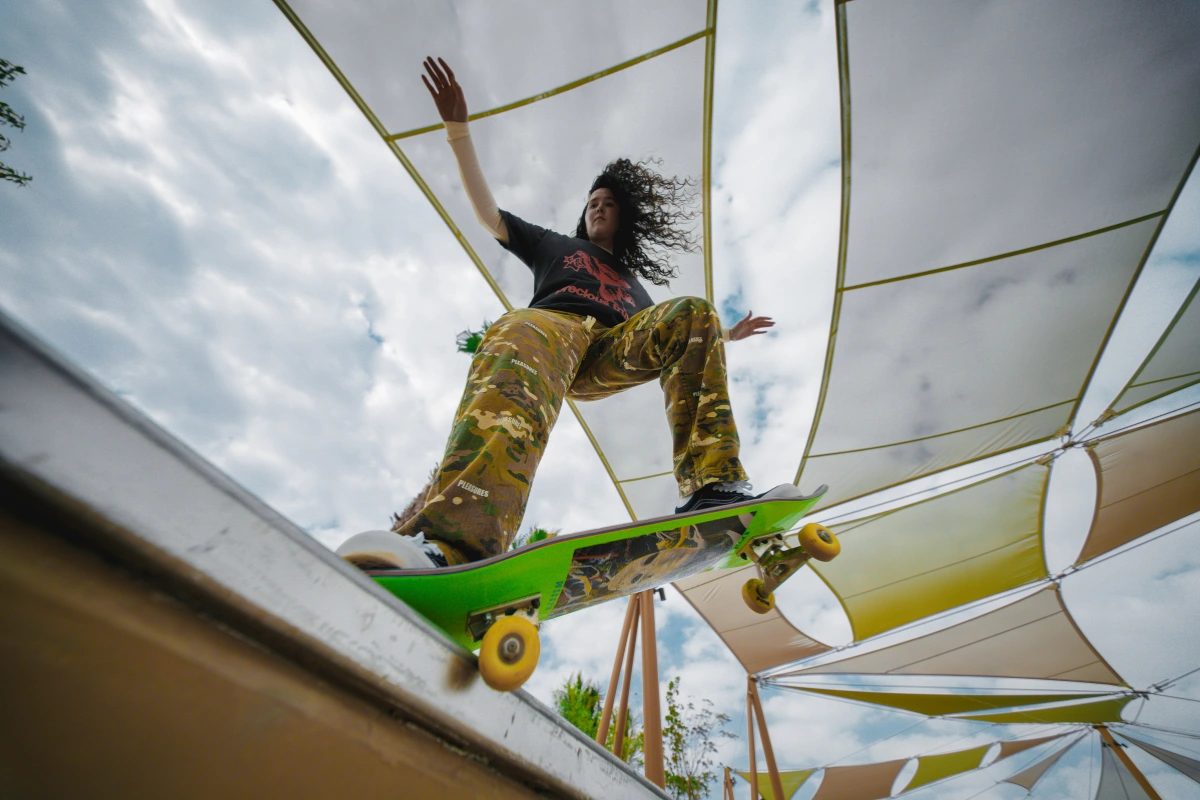
Abisha Safia first stepped on a skateboard as a child, and the sport quickly became a way for her to understand herself. It gave her confidence, fearlessness, ambition and a physical language for freedom. “I owe so much to skateboarding,” she says. “It showed me the best parts of myself, and also the hardest parts, through injuries and times of frustration.”

Growing up between Saudi Arabia and Los Angeles, Abisha’s relationship with skating was shaped by both access and absence. In Saudi, during her school years, she did not have friends who skated, and there were no skateparks around her at the time. Still, the lack of a scene did not stop her. “I was so in love with skating that the circumstances did not matter,” she says. “I would just skate in front of my house and listen to music.”
For Abisha, Women in Motion is about continuing forward, regardless of pace. “Life is a marathon, not a sprint,” she says. “As long as you don’t give up, you will get to where you want to be. Rest if you must, but don’t quit.”
Her routine today reflects that mindset. A training day often begins with a warm shower and coffee before gym work, weights and cardio. Later in the evening, she skates and works on new tricks. She is honest about the difficulty of discipline. Even top athletes, she points out, do not always enjoy pushing their bodies every day. “It starts with the mind,” she says. “If you can push through that mental barrier, your body will follow.”
When Abisha was growing up, there were very few girls skating around her. She was often the only girl at the skatepark. Watching the sport grow into a global platform, with major competitions and Olympic recognition, has shifted the scale of what feels possible. Having skated in contests across different countries, including Dew Tour and X Games, she now has her eyes on an even larger stage. “I would love to represent my country in the Olympics,” she says, “and encourage and motivate other women in Saudi Arabia.”

Her message to other women is rooted in staying close to the thing that first made them feel alive. “We usually know what we love from a young age,” she says. “The world sometimes tries to steer us away from it.” For Abisha, motion is the decision to keep returning to that truth, even when the path is uncomfortable, lonely or difficult.
“Stay true to who you are and what makes you feel most alive,” she says. “We get to do this life once, so make sure you find your happiness, peace and love for life along your journey.”
This article appears in Soigné Middle East Issue 003, Setting The Pace.